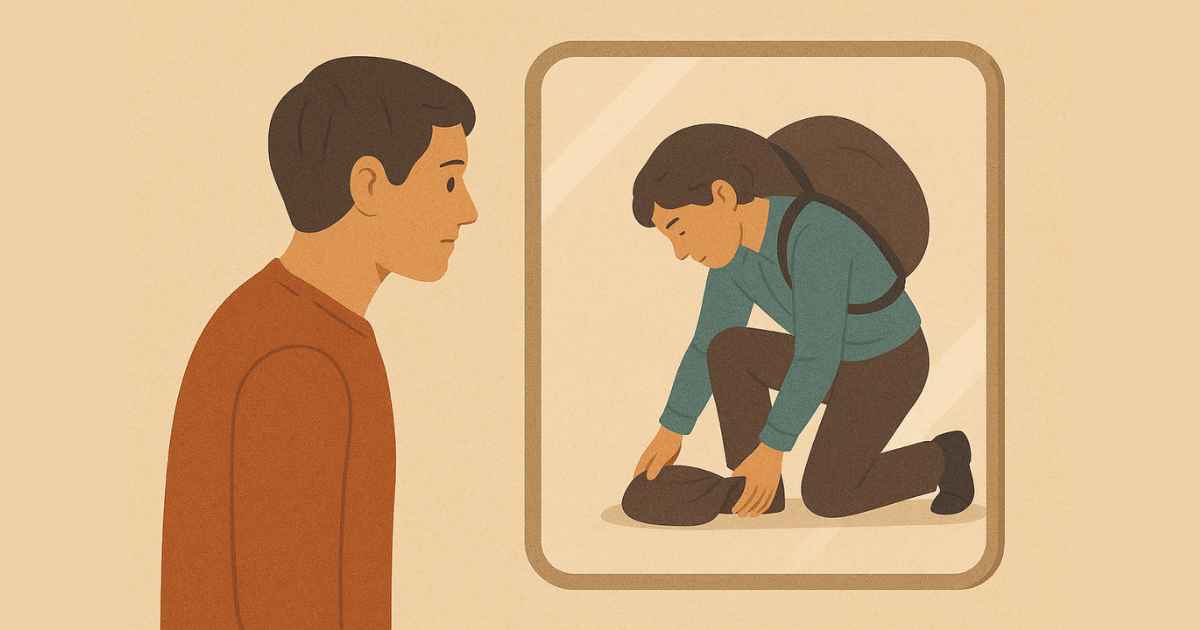
I have been doing men's work for over 20 years. I have sat with men in circles, coached them through identity shifts, and guided them through some of the hardest chapters of their lives. And one thing I keep seeing, over and over again, is a man who has done the reading, done the therapy, done the work, and still feels stuck.
Not lazy. Not broken. Stuck.
He knows what he should be doing. He understands his patterns intellectually. But something in his body just will not cooperate.
That is not a mindset problem. That is a nervous system problem. And it took sitting down with Dr. Somer Nicole on the Inner Edge Podcast for me to put cleaner language to something I have felt in the room with men for years.
Dr. Somer is a somatic therapist, nervous system educator, and creator of Somatic Reparenting. She started her career in physical therapy, spent 17 years studying what Western science left out, and now works at the intersection of the body, trauma, and deep healing. What she shared in our conversation stopped me in my tracks more than once.
Here are the biggest takeaways.
Dr. Somer made something very clear early in our conversation: trauma does not live in your thoughts. It lives in your physiology.
She told me about the clients who show up after years of talk therapy, self-help books, and personal growth work. They understand their patterns. They can explain their wounds. But they are still exhausted, still anxious, still shut down.
Because understanding something and healing it are two very different things.
The nervous system operates below the level of conscious thought. If your body does not feel safe, no amount of insight or positive thinking will pull you out of a survival state. You have to address the body directly.
This landed hard for me. Because so much of what men are handed, productivity systems, discipline frameworks, mindset resets, is all above the neck. And the body is just sitting there, dysregulated, waiting.
When most people think about a triggered nervous system, they picture fight or flight. Anger, anxiety, the urge to run.
But Dr. Somer introduced me to another state that is incredibly common, especially for men going through major transitions: the chronic freeze.
She went through it herself during a dramatic divorce in 2020. Here is how she described it in our conversation:
You have no energy. You want to withdraw, disconnect, isolate. The excuse you tell yourself is, I am just too tired. But what is actually happening is a specific physiological state of collapse. And it is a certain hell to live in because even when you are completely shut down, you can still be running massive internal anxiety at the same time.
That hit me. Because I have seen this in men. The guy who goes quiet. Who stops showing up. Who says he is fine but is clearly not there. He is not checked out because he does not care. He is frozen.
I know this state from the inside too. When I am shut down, my thoughts go completely dark. Nothing is working. Nothing will ever work. I cannot see options or possibilities. The curiosity I normally carry just disappears. All the good in my life becomes invisible and everything feels like it is failing. It is heavy. It is dull. And the worst part is it feels permanent, like this is just where I will be stuck forever.
And then I move. Some breathwork, a body-based practice, something that gets me out of my head and into my body. And within minutes, I can feel the thoughts starting to shift. A deeper sense of myself comes back online. Presence returns. Suddenly I can see possibility again. I start to trust my life and the experiences that brought me to this moment. Curiosity comes back. I come up with a few next steps and actually take action on them.
Same man. Same life. Completely different nervous system state. That is the whole game.
Signs of a chronic freeze response include chronic fatigue, a strong desire to isolate, emotional numbness, brain fog, and feeling like you know what you should do but cannot make yourself do it.
Dr. Somer explained nervous system states using a simple image called the autonomic ladder.
At the bottom is the freeze state. Immobilized, collapsed, disconnected. At the top is the ventral vagal state. Regulated, safe, connected, present. In the middle is the sympathetic nervous system. Fight, flight, mobilized energy.
Here is the key insight: to get from the bottom to the top, you have to pass through the middle.
You cannot go directly from frozen to regulated. You have to first mobilize the energy. That means developing a healthy relationship with what has been repressed, often anger, and using movement, breath, and sound to move stagnant energy through the body.
This is not about blowing up or losing control. It is about using the body intentionally to complete what the nervous system has been holding onto, sometimes for decades.
In our conversation, I shared something personal. When I first started feeling my emotions years ago, the anger felt enormous. Like the world might explode. And Dr. Somer affirmed something I had learned through that experience: the emotions are only that big because they have been held for so long. When you access them with the right tools, little by little, they get smaller. They become workable.
This was one of the most unexpected things Dr. Somer said in our conversation, and one of the most freeing.
There is an assumption in personal growth that processing heavy emotions requires intense screaming, cathartic releases, and going all the way to the edge. And sometimes that has its place. But Dr. Somer said something she has come to believe deeply:
We just do not have to heal with so much intensity.
The nervous system actually learns faster through play, pleasure, and delight than it does through grueling intensity. She teaches slow, nonlinear movement practices where you can let anger burn through your muscles while still feeling safe and grounded. You can be oriented toward pleasurable sensation and processing emotion at the same time. They are not opposites.
This matters for men especially. Because a lot of men white-knuckle their way through growth. They turn healing into another thing to push through. And that approach can actually further dysregulate the system you are trying to heal.
Dr. Somer said this and it is worth sitting with:
Your physiological state precedes your story.
Meaning, the nervous system state your body is in comes before the narrative your mind builds around it. If you are in a defensive, survival state, your mind is going to orient toward negativity, worst-case scenarios, and rumination. That is not a character flaw. It is biology.
So the men who are stuck in their heads, looping in anxious thoughts or harsh self-criticism, often cannot think their way out because the body is driving the bus. Address the body first. Change the state. The thoughts will follow.
I have watched this happen in my own somatic therapy sessions. My therapist would have me breathe and feel into my body for a few minutes. Five minutes later, the thought that life was falling apart would loosen into something like, actually, things are okay. Same conversation. Different nervous system state.
Dr. Somer closed our conversation with something that has stayed with me.
All of this work, every tool, every practice, every hard session, is about one thing: going from survival mode to creation mode.
When you are stuck in chronic survival, you are in a defensive posture. You cannot access creative solutions, joy, or the deeper sense of what you are here to do. Your life force energy, your creative energy, your presence in relationships, all of it is being consumed by the task of just getting through.
When you bring your physiology back to a baseline of safety, something opens. You get access to yourself again. To your purpose, your relationships, your capacity to actually feel alive.
That is what the work is for.
Here is what I want you to hear directly, man to man.
If you feel scattered and cannot follow through, if you feel emotionally numb but also anxious underneath it, if you feel disconnected from the people you love and cannot explain why, if you have done the intellectual work and you are still stuck, this is not a willpower problem. This is not a discipline problem. Your nervous system is doing exactly what it was designed to do in the face of chronic stress and unresolved emotion. It is protecting you.
The question is whether you are ready to give it something better than protection. Something like actual safety.
That requires community, body-based tools, and support from people who can hold regulated space while you do the work. Because as Dr. Somer said, one of the fastest ways to shift a dysregulated nervous system is to come into connection with someone who is already regulated. That is co-regulation. And it is one of the most powerful arguments for doing this work alongside other men rather than alone in your head.
Nervous system dysregulation is when the body gets stuck in a state of chronic stress response, whether fight, flight, or freeze, and loses the ability to return to a calm, regulated baseline on its own. It affects sleep, digestion, focus, relationships, and emotional wellbeing. It is extremely common, especially in high-achieving men who have carried significant stress or unresolved trauma for years.
Fight and flight are active survival responses, anger, anxiety, the urge to move or escape. Freeze is a collapsed, immobilized state where the body shuts down to conserve energy. It often shows up as chronic fatigue, emotional numbness, the desire to withdraw, and an inability to take action even when you know what to do.
You can make meaningful progress with somatic tools like breathwork, movement, and body-based awareness practices. But the nervous system heals most efficiently in connection with other regulated humans. Isolation is one of the things that keeps you stuck. Community, somatic therapy, and environments of safe connection are some of the most powerful accelerants of this kind of healing.
Somatic therapy is a body-based approach to healing that addresses trauma and emotional patterns at the level of the nervous system, not just the mind. Rather than talking about experiences, somatic therapy uses physical sensation, breath, movement, and sound to process what the body has been holding. It is particularly effective for people who have done significant talk therapy but still feel stuck.
Co-regulation is what happens when a dysregulated person comes into connection with someone who is in a calm, regulated state. Without any conscious effort, the nervous systems begin to sync. It is one of the fastest ways to shift out of a survival state and one of the strongest arguments for doing this work in a supported community rather than in isolation.
Common signs include chronic fatigue, difficulty taking action even when you know what you should do, emotional numbness, brain fog, a strong desire to isolate or withdraw, and feeling physically heavy or shut down. Many men in a freeze response are also running significant background anxiety at the same time, which makes the state particularly exhausting and disorienting.
If this conversation landed for you, there are two ways to go deeper with Inner Edge.
1-on-1 Coaching with Soleiman
Private coaching built around helping you get to the identity and nervous system level of what is keeping you stuck, not just the surface behaviors. This is for the man who is ready to stop managing symptoms and start doing the real work from the inside out.
The Inner Edge Men's Community
A private community of men committed to growth, presence, and showing up fully in every area of life. You will find the co-regulation, accountability, and brotherhood that the nervous system actually needs to heal. You do not have to do this alone.
Hear the full conversation with Dr. Somer Nicole on your platform of choice: YouTube | Spotify | Apple | SoundCloud
Want just the somatic exercise she led live: YouTube | Spotify | Apple | SoundCloud